


If you’ve ever specified or installed nylon cable ties in an outdoor, coastal, tropical, or wet industrial environment and wondered whether the surrounding humidity is slowly working against you — you’re asking exactly the right question. The answer is yes, moisture does affect nylon cable ties, and understanding how it does so is the difference between an installation that lasts a year and one that holds up for a decade.
Nylon is one of the most widely used engineering polymers in the world, and cable ties made from it are trusted across thousands of industries. But nylon has a well-documented characteristic that every engineer, contractor, and procurement specialist working in wet or humid environments needs to understand: it is hygroscopic, meaning it naturally absorbs moisture from the air and from direct water contact. This is not a flaw — it is a fundamental material property — but it has real consequences for how cable ties perform over time in humid and wet conditions.
This guide covers everything you need to know about nylon water absorption in cable ties — what happens chemically and mechanically, which environments cause the most damage, how different nylon types compare, and how to choose the right product so that moisture works with your installation rather than against it. Whether you’re managing outdoor electrical installations, tropical construction projects, or cold storage facilities, the information here will help you make a better, more confident specification decision.
What Does It Mean That Nylon Is Hygroscopic?
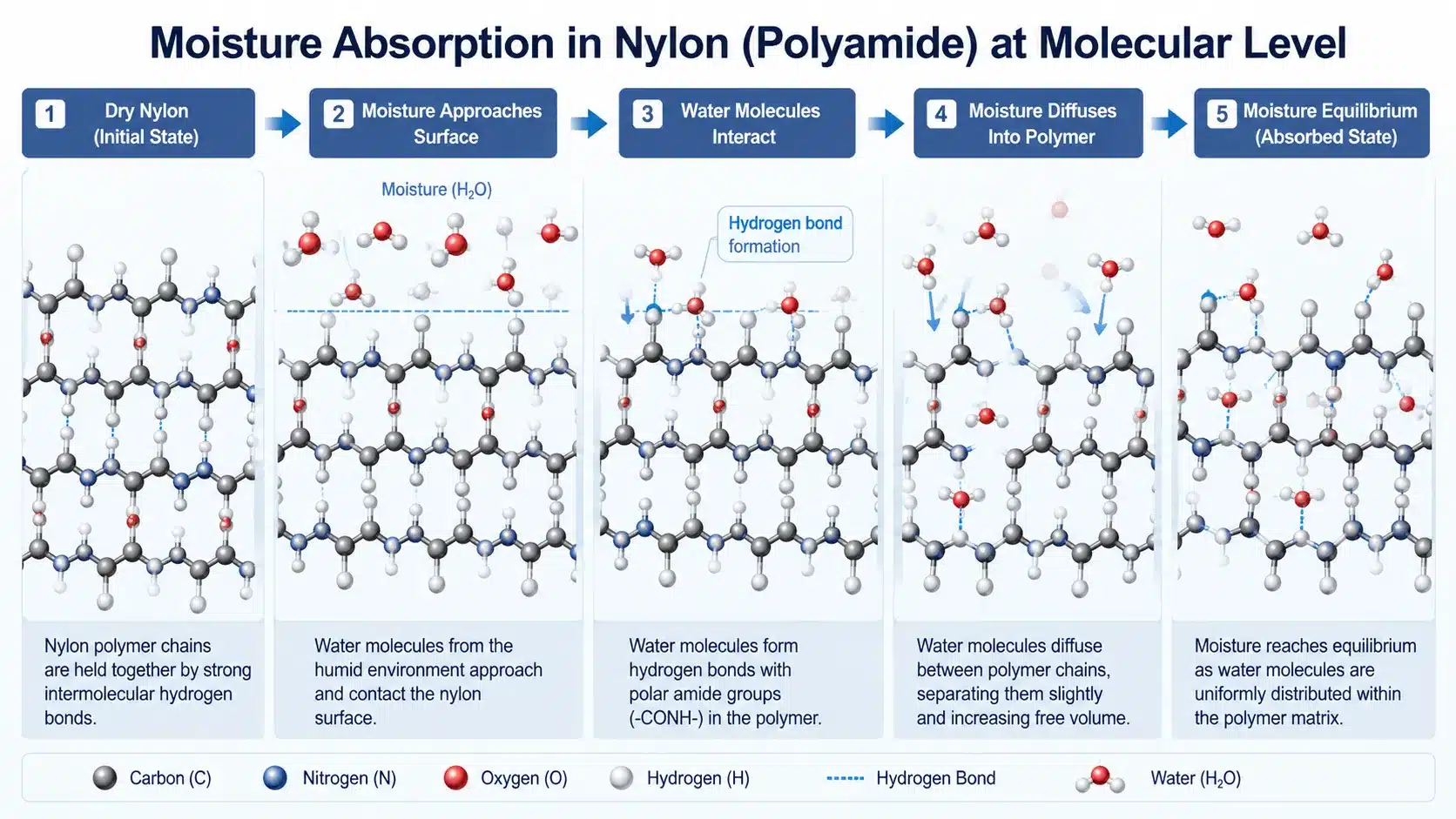
The term hygroscopic refers to a material’s natural tendency to absorb and retain water molecules from its surrounding environment. For nylon — specifically the polyamide polymer chains that give cable ties their strength and flexibility — this means water molecules gradually migrate into the internal structure of the material, even without direct liquid contact.
This is not the same as dissolving or corroding. Nylon does not break down immediately in the presence of water the way some metals rust or some polymers swell and distort. Instead, nylon water absorption is a gradual, equilibrium-driven process. The nylon draws in moisture until it reaches an equilibrium with the humidity level of its surrounding environment, at which point absorption slows to a near-stop. In a dry indoor warehouse at 50% relative humidity, standard Nylon 66 will absorb roughly 2.5% of its own weight in moisture and then stabilise. In a fully immersed or continuously saturated environment, that figure rises to as much as 8 to 9%.
The implications of this are more significant than they might initially appear. As water molecules integrate into the nylon polymer chains, they act as a plasticiser — they occupy space between the polymer chains, increasing the distance between them and reducing the intermolecular forces that give the material its stiffness. The result is a material that is slightly more flexible and ductile when wet, but measurably weaker in tensile strength. Depending on the application, this change can be a negligible background factor or a critical engineering consideration.
How Quickly Does Nylon Absorb Moisture?
The rate of nylon moisture absorption depends on the surface area of the material, the ambient temperature, and the humidity or water exposure level. A thin cable tie strap has a high surface-area-to-volume ratio, which means it equilibrates with its environment relatively quickly compared to a thick moulded nylon component. In a humid outdoor environment, a standard nylon cable tie can absorb a significant portion of its equilibrium moisture content within the first few days of installation.
Temperature accelerates the process considerably. At higher temperatures, water molecules move faster and penetrate the nylon structure more rapidly. This is why wet-heat environments — such as tropical climates, coastal industrial sites, and steam-exposed plant rooms — are among the most aggressive environments for nylon cable ties. The combination of warmth and moisture pushes absorption faster and deeper than either condition would achieve alone.
Is Moisture Absorption Reversible?
Yes — moisture absorption in nylon is largely reversible. If a wet environment cable tie is moved to a dry environment, it will gradually release the absorbed moisture and return toward its dry-state mechanical properties. However, this reversibility matters less in real applications than it might suggest, because outdoor and wet-environment installations do not experience clean drying cycles. They experience repeated wetting and partial drying — rain followed by sunshine, humidity fluctuating through the day — and these repeated cycles are where the cumulative damage occurs.
Each time nylon absorbs and releases moisture, micro-stresses develop in the polymer structure. Over many cycles, these stresses accumulate and contribute to surface crazing, micro-cracking, and gradual embrittlement — long before any single dramatic failure event. This is why a cable tie that has been in an outdoor installation for three years may appear visually intact but have significantly reduced tensile and impact performance compared to a new tie of the same type.
How Moisture Changes the Mechanical Performance of Nylon Cable Ties
Tensile Strength Reduction
The most directly measurable consequence of nylon water absorption is a reduction in tensile strength. Standard Nylon 66 can lose up to 20% of its dry-state tensile strength when fully saturated with moisture. For Nylon 6, which absorbs slightly more moisture, that reduction can reach 25%. In an application where the cable tie is already operating at a significant proportion of its rated tensile capacity — a large cable bundle, a heavy conduit, or a load-bearing installation — a 20% reduction is not trivial.
In practice, well-specified cable ties include a safety margin above the expected load, which means minor moisture-related tensile reduction does not immediately translate into failure. The risk increases when the margin is thin — when a contractor has selected a tie rated just above the expected load, or when the load itself increases over time as additional cables are added to a bundle. Under these conditions, moisture-driven tensile reduction can push the tie into its failure zone.
Changes in Flexibility and Impact Resistance
Moisture also affects how a nylon cable tie behaves under dynamic load — that is, under impact, vibration, or sudden stress rather than steady tension. When nylon absorbs moisture, it becomes marginally more ductile and impact-resistant in its wet state. This sounds positive, and in some contexts it is — a wet nylon tie is slightly better at absorbing a single sharp blow without cracking than a completely dry one.
The problem arises when the installation experiences repeated drying cycles. A tie that has absorbed moisture and then dries out — particularly in combination with UV exposure — does not simply return to its original state. The drying process can cause internal stress and surface micro-cracking, leaving the material in a weaker condition than it was before it got wet in the first place. This is why cable ties in outdoor environments with significant moisture variation — wet seasons followed by dry, or coastal environments with high day-to-night humidity swings — age faster than those in either consistently dry or consistently wet conditions.
Dimensional Stability
Nylon expands slightly when it absorbs moisture — a property known as hygroscopic expansion. For most cable tie applications, this dimensional change is small enough to be irrelevant. However, in precision applications where the tie is installed in a confined space alongside other components, or where the locking mechanism relies on tight dimensional tolerances, hygroscopic expansion is worth being aware of. PA12 cable ties — which absorb only a fraction of the moisture that standard PA66 ties do — are significantly more dimensionally stable and are often preferred in automotive and precision engineering applications for this reason.
Cable Tie Humidity: How Different Environments Compare
Not all wet environments are the same, and understanding the specific humidity and moisture profile of your installation environment is essential to making the right cable tie specification. Cable tie humidity risk ranges from negligible in dry indoor settings to critical in permanently saturated or chemically contaminated wet environments.
The table below sets out nine common installation environments, their humidity characteristics, the moisture risk they present to standard nylon cable ties, and the appropriate cable tie specification for each. This is intended as a practical planning reference, not just a theoretical exercise — the recommendations are based on real application experience across the industries we serve.
| Environment | Humidity Level | Moisture Risk to Standard Nylon | Recommended Cable Tie Specification |
| Dry indoor office / warehouse | 30–50% RH | Very Low — equilibrium reached quickly | Standard Nylon 66 |
| Standard indoor with seasonal variation | 40–70% RH | Low — minor property variation only | Standard or UV-stabilised Nylon 66 |
| Tropical / high-humidity indoor | 70–90% RH | Medium — accelerated moisture absorption | UV-stabilised Nylon 66 or PA12 |
| Outdoor — temperate climate | Variable, rain exposure | Medium-High — UV + moisture combined | UV-stabilised Nylon 66 |
| Outdoor — tropical or monsoon climate | Continuous high humidity + rain | High — rapid compound degradation | PA12 or stainless steel |
| Cold storage / refrigeration | High humidity + low temp | High — moisture + brittleness risk | PA12 (low-temp + moisture stable) |
| Coastal / marine adjacent | Salt-laden humid air | Very High — salt + moisture corrosive | Stainless steel 316 |
| Chemical plant / industrial wash-down | High humidity + chemical exposure | Critical — chemical + moisture attack | Stainless steel 316 or PVDF |
| Buried / underground installation | Continuous ground moisture | Critical — permanent inaccessible location | Stainless steel 316 only |
Nylon Cable Tie Outdoor Water Exposure: The Full Picture
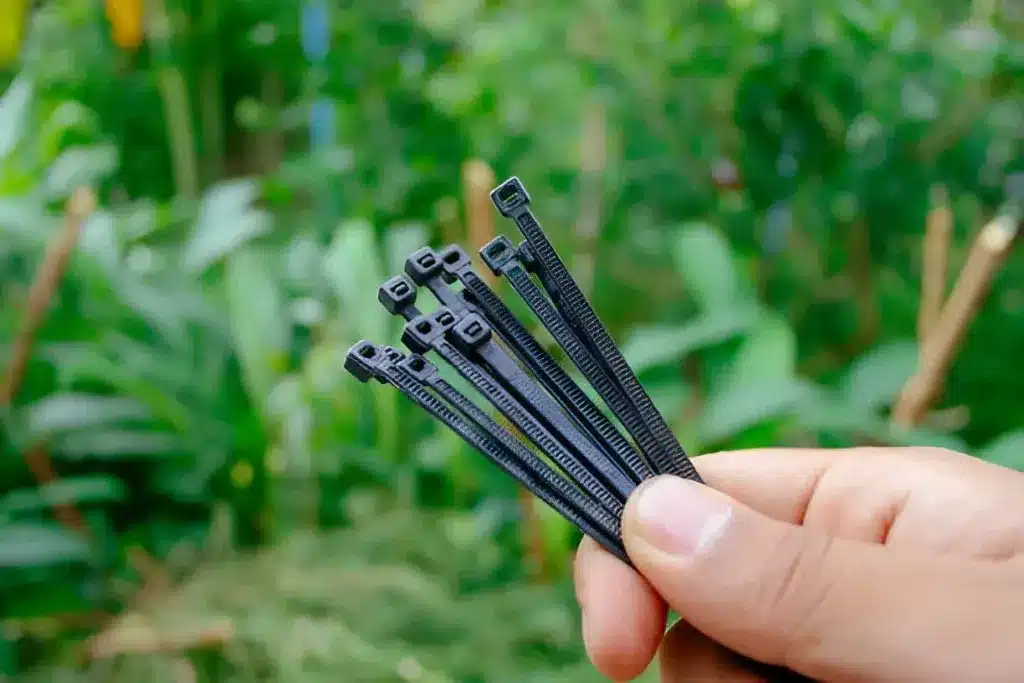
Outdoor installations present a uniquely compound challenge for nylon cable tie outdoor water exposure because moisture rarely acts alone. In any outdoor environment, a nylon cable tie is simultaneously dealing with UV radiation from sunlight, temperature cycling between day and night, mechanical stress from wind loading and vibration, and continuous moisture variation from rain, dew, and humidity.
Each of these factors degrades nylon independently. But the critical insight — one that is often missed in basic material specifications — is that they do not simply add their damage together. They compound it. UV radiation weakens the polymer chains at the surface. Moisture penetrates the weakened surface zone more rapidly than it would an intact surface. The weakened, moisture-saturated surface then responds more severely to temperature cycling stress. What might take many years to cause failure in a single-factor environment can happen in a fraction of that time when all four factors are acting simultaneously.
Based on our experience supplying cable ties for outdoor electrical and construction applications across diverse climates, standard Nylon 66 cable ties in high-UV and high-moisture environments can begin showing measurable performance degradation within 6 to 12 months. By contrast, UV-stabilised nylon cable ties engineered specifically for outdoor use maintain reliable performance for 5 to 10 years in the same conditions, because the UV-absorbing additives slow the photo-oxidation that opens the door to accelerated moisture ingress.
The Role of Humidity in Accelerating UV Degradation
One aspect of outdoor moisture exposure that receives less attention than it deserves is the way humidity directly accelerates UV-driven degradation. When nylon absorbs atmospheric moisture, the water molecules that integrate into the polymer structure increase the mobility of the molecular chains. This makes it easier for UV-generated free radicals — the reactive chemical species produced when UV light breaks nylon’s amide bonds — to propagate through the material and cause further chain scission.
In practical terms, this means that a cable tie installed in a hot, humid, high-UV environment — a tropical outdoor site, a coastal construction project, or a greenhouse — ages significantly faster than one in a dry environment with equivalent UV levels. The moisture does not need to cause visible surface changes to be accelerating internal degradation; by the time surface cracking or brittleness appears, the process has been underway for some time.
Cold, Wet Environments: A Specific and Underappreciated Risk
Cold and wet environments present a specific risk profile that is different from hot, wet conditions. When nylon has absorbed moisture and the temperature drops, the absorbed water can contribute to embrittlement — the same moisture that plasticises the nylon at room temperature becomes part of a more complex failure mechanism as temperatures approach and drop below freezing. PA12 cable ties are the professional solution for cold, wet environments specifically because their dramatically lower moisture absorption rate means this compound cold-wet failure mode is almost entirely avoided.
Explore our Nylon Cable Ties — including PA12 options for cold and wet-environment applications
Nylon Water Absorption Comparison: Which Cable Tie Material Handles Moisture Best?
The following table compares how different cable tie materials handle moisture absorption — across equilibrium absorption rate, immersion behaviour, and the practical impact on tensile strength and flexibility. Use this as a direct reference when choosing between materials for wet or high-humidity applications.
| Nylon Type | Moisture Absorption (23°C / 50% RH) | Moisture Absorption (Immersed) | Impact on Tensile Strength | Impact on Flexibility |
| Nylon 66 (PA66) — Standard | ~2.5% | ~8.5% | Decreases up to 20% when wet | Increases slightly when wet |
| Nylon 6 (PA6) | ~2.7% | ~9.5% | Decreases up to 25% when wet | Increases moderately when wet |
| Nylon 12 (PA12) | ~0.25% | ~1.4% | Minimal impact — highly stable | Minimal change across conditions |
| UV-Stabilised Nylon 66 | ~2.5% | ~8.5% | Same as PA66 but degradation slowed by additives | Similar to PA66 |
| Stainless Steel 304/316 | 0% | 0% | No change — unaffected by moisture | No change — unaffected by moisture |
Choosing the Right Cable Tie for Humid and Wet Environments
The decision framework for specifying the right wet environment cable tie is straightforward once you understand the moisture behaviour of each material. The key is to work from the environment outward — not from the product catalogue inward.
For dry and standard indoor environments where relative humidity stays below 60% and the temperature is controlled, standard Nylon 66 cable ties are appropriate and cost-effective. The moisture equilibrium they reach in these conditions has a negligible practical impact on performance, and the long service life of standard nylon indoors makes it an excellent value choice.
For outdoor installations in temperate climates — the majority of construction, electrical, and general industrial outdoor work — UV-stabilised Nylon 66 is the correct specification. The UV stabilisation slows the photo-oxidation that accelerates moisture ingress, extending outdoor service life from months to years. These ties handle typical rainfall, humidity variation, and seasonal temperature changes reliably. Shop UV-Stabilised Outdoor Cable Ties.
For high-humidity tropical environments, coastal installations with salt-laden air, cold storage facilities, and automotive external wiring, Nylon 12 (PA12) is the right step up. Its moisture absorption rate is four to five times lower than standard Nylon 66, which means it maintains much more consistent mechanical properties across the full range of humidity and temperature conditions it will encounter.
For permanent installations in continuously wet environments — underground cable management, marine dock wiring, offshore structures, and chemical plant applications — stainless steel is the only specification that provides genuinely long-term reliability. It absorbs zero moisture, experiences no hygroscopic dimensional change, and maintains its full mechanical properties regardless of humidity, temperature, or chemical exposure. The service life of a correctly specified stainless steel tie in a permanently wet environment is measured in decades, not years.
The principle that ties all of this together is simple: the cost difference between standard and upgraded cable tie specifications is always small relative to the cost of installation labour, maintenance visits, and the risk of failure in a finished project. Getting the moisture specification right at the planning stage is one of the highest-value, lowest-cost decisions in any outdoor or wet-environment project.
How to Tell If Moisture Has Already Damaged Your Cable Ties
If you are inspecting an existing outdoor or wet-environment installation to assess whether the cable ties need replacing, the following signs indicate that moisture-related degradation has progressed to the point where replacement should be prioritised. These are the warning signs our team consistently identifies in field assessments of long-term outdoor installations.
- Surface crazing or micro-cracking: Fine surface cracks, often appearing in a network pattern on the strap or around the locking head, indicate repeated wet-dry cycling stress. This is a clear signal that the tie’s structural integrity is compromised.
- Unusual rigidity in combination with surface changes: A tie that has lost its characteristic slight flexibility and feels stiff or brittle when pressed is showing signs of advanced moisture-UV compound degradation.
- Discolouration alongside brittleness: Yellowing or browning of a nylon tie is primarily a UV degradation signal, but when combined with brittleness it indicates that the photo-oxidation has created pathways for accelerated moisture ingress, significantly weakening the material.
- Loss of tensile resistance when tested by hand: A correctly installed tie should resist hand-pulling firmly. If it deflects or deforms easily under modest hand pressure, or snaps rather than stretching slightly, it has lost a significant portion of its original tensile strength.
- Locking head failure or slippage: In some cases, moisture-related swelling and subsequent drying cycles cause dimensional changes in the locking mechanism that reduce the self-locking force. If the tie can be manually pushed back through the head without the usual resistance, it should be replaced immediately regardless of the strap’s appearance.
Any tie showing two or more of these signs simultaneously should be considered end-of-life and replaced before the installation is subjected to further load or environmental stress. In safety-critical applications — electrical panel wiring, scaffolding fixings, or structural cable management — a single clear sign is sufficient reason for immediate replacement.
Frequently Asked Questions
Does moisture affect nylon cable ties permanently?
Moisture absorption in nylon is partially reversible — nylon cable ties will release absorbed moisture in drier conditions and recover some of their original mechanical properties. However, repeated wet-dry cycling causes cumulative micro-stress and surface degradation that is not reversible. Over time, the compound effects of moisture, UV, and temperature cycling cause permanent performance reduction that worsens with each cycle.
How does humidity affect nylon cable tie performance?
Elevated cable tie humidity increases the rate at which nylon absorbs atmospheric moisture, which softens the polymer slightly, reduces tensile strength, and alters dimensional stability. In consistently high-humidity environments — tropical climates, coastal areas, and industrial wet areas — the cumulative effect is accelerated ageing of standard nylon cable ties. UV-stabilised nylon or PA12 cable ties are better suited to these conditions because they either slow the degradation process or absorb significantly less moisture from the outset.
Which nylon type is most resistant to moisture absorption?
Among nylon variants, Nylon 12 (PA12) has the lowest moisture absorption rate — roughly four to five times lower than standard Nylon 66. This makes it the most moisture-resistant nylon cable tie material available, and the preferred choice for outdoor, automotive, and cold-wet environment applications. For zero moisture absorption, stainless steel cable ties are the definitive answer.
Can I use standard nylon cable ties in high humidity environments?
Standard nylon cable ties can be used in moderately humid environments — up to around 60 to 70% relative humidity — without significant performance concerns for typical load applications. Above this level, or in any environment combining high humidity with UV exposure and temperature cycling, UV-stabilised nylon or PA12 cable ties are the appropriate specification. Standard nylon in continuously high-humidity outdoor conditions will begin showing performance degradation within months rather than years.
How do I know if moisture has weakened my outdoor cable ties?
The most reliable indicators of moisture-related degradation in outdoor cable ties are surface crazing or micro-cracking, unusual rigidity combined with discolouration, and reduced resistance to hand pressure — a tie that deflects or snaps rather than holding firm. Any cable tie showing these signs in a load-bearing or safety-critical application should be replaced immediately, before failure rather than after it.
Does moisture affect the colour of nylon cable ties?
Moisture alone does not typically cause visible colour change in nylon cable ties. The yellowing and browning commonly seen in outdoor cable ties is primarily caused by UV degradation — specifically the photo-oxidation of the nylon polymer chains. However, moisture accelerates UV degradation by weakening the surface layer and facilitating deeper penetration of UV-generated reactive species. So while moisture is not the direct cause of colour change, it is a significant accelerant of the UV-driven process that is.
Are outdoor cable ties moisture proof?
No cable tie material is completely moisture-proof in the sense of being impermeable to water vapour — even stainless steel can have surface condensation. However, stainless steel cable ties are unaffected by moisture in any mechanically meaningful sense, making them as close to moisture-proof as any cable tie product available. UV-stabilised nylon and PA12 cable ties are moisture-resistant rather than moisture-proof, but their enhanced formulations provide reliable performance in outdoor conditions for significantly longer than standard nylon alternatives. Browse Outdoor Cable Ties — weatherproof specifications for exposed applications.
Conclusion: Moisture Matters — And the Right Specification Solves It
Does moisture affect nylon cable ties? Absolutely — and in ways that go beyond simple surface damage. From tensile strength reduction and hygroscopic expansion to compound UV-moisture degradation and cold-wet embrittlement, the interaction between nylon and moisture is one of the most important material considerations in outdoor and wet-environment cable tie specification.
The good news is that every moisture-related failure mode we have described in this guide is entirely preventable through correct product selection. Standard nylon for dry indoor environments. UV-stabilised nylon for typical outdoor use. PA12 for high-humidity, cold, or automotive applications. Stainless steel for anything permanent, structural, or in a continuously wet or chemically demanding environment.
These are not complicated decisions — they are straightforward engineering choices that cost very little extra at specification stage and save significantly more in maintenance, replacement, and risk over the life of a project. The cable ties you choose today are going to be in your installation for years. Choosing the right one for the moisture environment they face is the single most important decision in that process.


