


Metal Zip Ties — Which Type Your Job Actually Needs
Metal zip ties hold where nylon gives up — in heat, chemicals, salt spray and UV that break plastic down within a season. We make them at our own plant in Bozhou, Anhui: ball-lock, plate-lock, coated and releasable, in 201, 304 and 316 stainless, 3 mm to 12 mm wide and 100 mm to 1050 mm long, holding 10 kg to 120 kg. This page sets out the differences so you can choose the right type before you send us a size list.
ISO 9001CERoHS201 / 304 / 31610–120 KG100–1050 MM
The metal cable ties we manufacture
Four families, one factory. They differ in how the head locks, how the strap is finished and how much load it will hold — and that is what decides which one belongs on your job.

Ball-Lock Stainless
The self-locking ball head, in 201, 304 or 316. Widths of 4.6 mm, 7.9 mm and 12 mm holding 60 kg, 80 kg and 120 kg, in lengths from 100 mm to 1050 mm. Non-releasable and tamper-resistant. See sizes and grades.

Coated — PVC and Epoxy
The same stainless core under a black polymer coat that resists abrasion, UV and salt spray, and keeps the steel from sitting directly against dissimilar metals. Available PVC coated or epoxy coated.
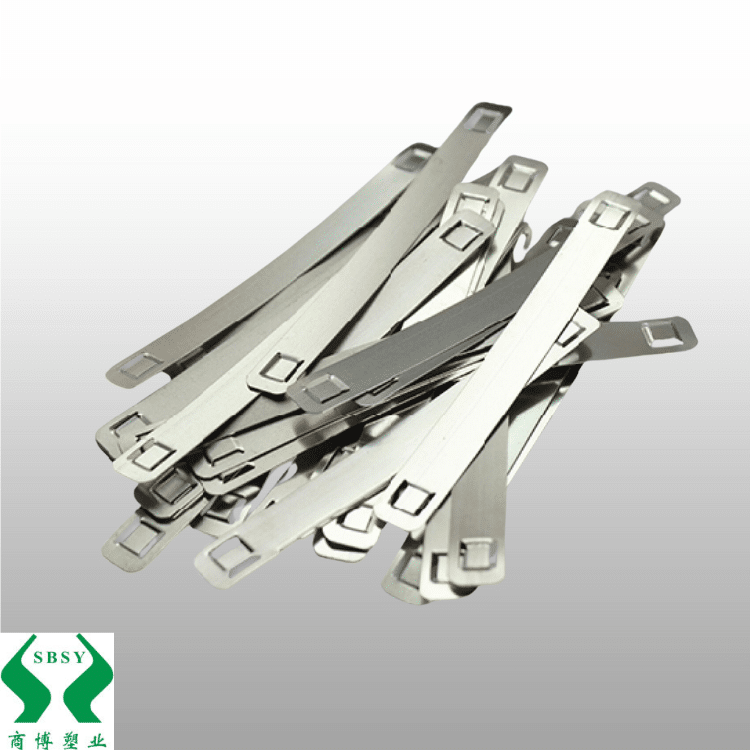
Plate-Lock and Releasable
Plate-lock ties (also called L-type) run 3 mm to 10 mm wide and hold 10 kg to 90 kg — the lighter end of the range, used for marking, signage and light fixing. Releasable stainless ties open and re-tension for panels that get opened again.
When steel is worth the cost over nylon
Nylon covers most bundling work at a fraction of the price, and we would rather sell you the right tie than the expensive one. Steel earns its cost in four situations: sustained heat, chemical exposure, salt water, and anywhere a failed tie turns into a safety incident. If you are weighing the two, our nylon versus stainless comparison goes through it properly.
| Type | Material | Temperature | Tensile Strength | Best For |
|---|---|---|---|---|
 Nylon ties | PA66 nylon | −40°C to +85°C¹ | 18–250 lbs (8–120 kg) | Electrical, construction, general bundling |
 Ball-lock stainless | SS201 / SS304 / SS316 | High-temp & fire-resistant | 60–120 kg (135–270 lb) | Marine, tunnels, refineries, extreme heat |
| Coated stainless | Stainless core + PVC or epoxy | −40°C to +150°C | 60–120 kg (135–270 lb) | Coastal, direct burial, mixed-metal runs |
| Plate-lock (L-type) | Stainless | High-temp & fire-resistant | 10–90 kg | Marking, signage, light structural fixing |
¹ Special nylon grades are available for continuous use up to +105°C / +120°C. Exact temperature and tensile limits are confirmed against your specification before order.
Holding strength, from 10 kg to 120 kg
An orientation rather than a size chart — the full tables, item numbers and bundle diameters live on each product page. Larger sizes are available. The tiers above are what we hold as standard — longer lengths, wider straps and higher load ratings are produced to order. Send us the bundle diameter, the load you need to hold and the quantity, and we will quote it, with free samples before you commit.
| Tier | Strap width | Min. loop tensile | Typical use |
|---|---|---|---|
| SST | 4.6 mm | 60 kg (135 lb) | Cables, hoses and light structures |
| SHD | 7.9 mm | 80 kg (180 lb) | Larger bundles and heavier pull loads |
| SED | 12.0 mm | 120 kg (270 lb) | Heavy pipe and large-diameter bundles |
| Plate-lock | 3–10 mm | 10–90 kg | Marking, signage and light fixing |
The tools that tension and cut them
A steel strap is tensioned and cut in one action with a hand tool, which is what gives you an even wrap and a flush, snag-free tail. We supply two hand tools: the SBS-600A (0.30 kg, straps up to 4.8 mm, lengths 50–350 mm) and the SBS-519 (0.26 kg, straps up to 9.0 mm, lengths 50–500 mm). Confirm tool and strap compatibility with our team before ordering, as the right tool depends on the strap width and grade you choose.


How to take one off again
This is the question installers ask most, usually after the first one goes on and will not come back off. There are three answers, and only one of them is reliable.
| Method | What you need | Notes |
|---|---|---|
| Cut the strap | Flush cutters or a tie tool | Fastest and most reliable. The tie is scrap afterwards — leave no sharp tail behind. |
| Release the ball | Fine flat screwdriver | Possible on some ball-lock heads by lifting the ball while easing the strap back. Not guaranteed, and not a design feature. |
| Use a releasable type | Nothing | Built to open and re-tension. Specify it up front if the bundle will be opened again. |
Fitting a steel tie, step by step
Seven steps from loose strap to a finished wrap that will not work its way open.
01
Size it
Bundle diameter plus enough strap to reach through the head and give the tool something to pull.
02
Wrap the bundle
Keep the strap flat against itself; a twisted strap tensions unevenly.
03
Feed the head
Pass the strap through the ball-lock head from underneath so the ball bites on the pull.
04
Take up the slack
Pull it hand-tight first so the tool starts from a closed wrap, not a loose one.
05
Tension with the tool
Even, steady pull. Stop at the tension the job needs, not at the tool’s limit.
06
Cut flush
The tool shears at the head. A proud tail on a steel tie is a laceration risk.
07
Check the tail
Run a gloved hand over the head. No burr, no lift, no movement in the wrap.
Not sure which type fits? Send your bundle diameter and the environment it lives in.
The factory behind these ties
Two decades of factory-direct manufacturing, and metal ties made on the same site and the same quality system as everything else we ship.
Black and other finish options
Black on a steel tie comes from the coating, not the metal — so black metal zip ties are coated ties, and the coating is doing a second job as abrasion and UV protection. Bare stainless ships in its natural finish. For colour-coded identification, marking ties carry the colour on the label rather than the strap.
Natural stainless Black PVC coated Black epoxy coated 201 / 304 / 316 Ball-lock Plate-lock Releasable
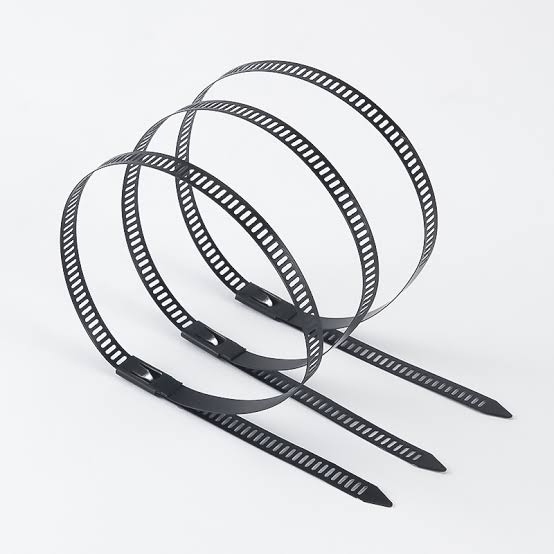
PVC coated ties for coastal and buried runs
A black PVC jacket over a 201, 304 or 316 core, rated −40°C to +150°C, flame-retardant and salt-spray resistant, and suitable for direct burial. The coating also stops the steel sitting bare against another metal, which is where galvanic corrosion starts. Full coated specification.
Which core grade sits under that jacket still matters. The coating protects the steel from abrasion and from direct contact with another metal, but it is not a substitute for the right grade in a chloride environment — specify 316 for salt water and keep 304 for general outdoor work. Remember too that the jacket adds to the finished strap thickness, so if you are working to a tight bundle diameter or through a fixed aperture, check the coated dimensions rather than the bare ones.
Epoxy coated ties for abrasion and chemicals
A thermosetting epoxy powder finish over the same stainless core — a harder, more abrasion-tolerant coat than PVC, which suits handling-heavy and chemically aggressive installations. Same strap widths and the same strength tiers. See epoxy coated ties.
The practical difference from PVC is how the coat behaves under friction. A thermosetting powder bonds hard to the strap, so it holds up where ties are dragged over edges, re-routed during commissioning, or cleaned down repeatedly. PVC stays softer and more flexible, which suits buried and coastal runs better. If you are not sure which fits your installation, tell us how the ties will be handled and where they will sit — that usually decides it faster than a datasheet does.
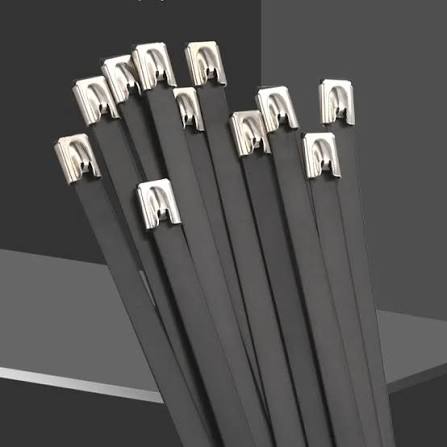
Where steel ties actually get used
The jobs where the environment, not the load, is what rules nylon out.

Fencing & Perimeter
Chain-link, mesh and agricultural fencing that sits in full sun and weather for years, where a UV-degraded plastic tie means walking the whole line again.

Automotive & Exhaust
Exhaust wrap, heat shielding and under-body work close to hot components, plus CV boot and hose clamping where heat and road salt both apply.

Marine & Offshore
Decks, rigging, docks and offshore structures. This is 316 territory — chlorides find any weakness in a lower grade.

Solar & Utilities
Panel arrays, cable trays and pole-mounted runs with a design life measured in decades and no appetite for a maintenance visit.

Tunnels, Rail & Fire-Critical
Where a tie has to survive a fire rather than feed it, and where cables must stay supported for as long as the structure does.

Chemical & Process Plants
Refineries, chemical lines and wash-down areas where solvents, acids and steam cleaning would attack a polymer tie.

Reusable metal cable ties for panels you open again
Standard ball-lock ties are one-way by design — that is the point of a tamper-resistant head. When a bundle has to be opened for maintenance, specify releasable stainless instead and you keep the corrosion and temperature performance without cutting a tie off every service visit. Releasable stainless ties.
It is worth being honest about the trade-off: a releasable head gives up some of the tamper resistance that makes a one-way ball-lock attractive in the first place. Where security matters more than access, stay with the standard head and budget for replacing ties at each service. Where a panel is opened on a schedule, the releasable type pays for itself in labour within a few visits. Current sizes and grades for the releasable line are confirmed with our team before ordering.
Certified, compliant and ready for your audit file
Independently issued documentation travels with the order, and we send it before you buy if your approval process needs it first.

How we control quality on every batch
Controlled from incoming raw material to final shipment rather than checked at the end — grade verification on the steel, dimensional checks in production, and loop tensile testing before packing.
In practice that means the steel is checked on arrival against the grade we ordered, strap width and length are measured during production rather than sampled at the end, and finished ties are pulled on a tensile bench before they are packed. Documentation travels with the shipment, and we are happy to have third-party inspectors attend before despatch — several of our distributor customers book one as standard, and it has never been a problem from our side.
Need a custom length, grade or marking?
Beyond the stock tiers we cut bespoke lengths, supply specific grades, and laser-mark or label ties for identification. Private-label packaging is a standard service. Tell us the application and we will come back with what is workable.
Most custom requests fall into three buckets: a length we do not hold as standard, a specific grade for an approval or specification, and identification — marking, labelling or private-label packaging carrying your own brand. Tooling and setup costs depend on which of those you need and on the quantity behind it, so send the application, the volume and the destination country together and we will come back with what is workable and what it would cost.

The plant these ties come from
Real photographs from our Bozhou, Anhui site — the machines, the testing bench and the people behind the order.


Frequently asked questions
Are metal zip ties stronger than plastic ones?
Yes, and by a wide margin at the top of the range — our stainless tiers hold 60 kg, 80 kg and 120 kg, and they do not soften with heat or go brittle with UV the way nylon eventually does. But strength is rarely the reason to switch. Nylon handles most bundling jobs perfectly well at a fraction of the cost. Steel earns its price in sustained heat, chemical exposure, salt water, and anywhere a failed tie becomes a safety problem.
How do you tighten a steel cable tie properly?
Feed the strap through the head, pull the slack through by hand, then tension with a hand tool rather than pliers. The tool applies an even pull and cuts flush at the head in the same action. Pliers tend to leave the wrap under-tensioned and the tail sharp, which is how installers cut their hands on steel ties.
How do you remove or undo one?
Cutting the strap with flush cutters is the reliable way, and the tie is scrap afterwards. Some ball-lock heads can be eased open with a fine flat screwdriver by lifting the ball while you back the strap out, but that is not a design feature and we would not build a maintenance routine around it. If the bundle will be opened again, specify releasable stainless ties instead.
What temperature can they handle?
Bare stainless is the high-temperature option in our range and is also fire-resistant, which is why it is specified in tunnels, refineries and rail. Coated ties are rated −40°C to +150°C because the polymer coating, not the steel, sets the ceiling. Exact limits are confirmed against your specification before order — there is more detail in our guide to materials for high-temperature ties.
Which grade should I choose — 201, 304 or 316?
304 is the general-purpose choice and covers most outdoor, industrial and construction work. 316 adds molybdenum for salt water, chlorides and aggressive chemicals, so it is the marine and offshore grade. 201 is the economical option for indoor or general bundling where cost leads. Full grade detail sits on the stainless product page.
Do you supply them in black?
Yes. Black comes from the coating rather than the steel — both our PVC coated and epoxy coated lines are black as standard, which also gives you abrasion and UV protection. Bare stainless is supplied in its natural finish.
What is the minimum order and lead time?
MOQ is flexible, with small trial quantities available so you can test the product before committing to volume. Lead time depends on grade, length and whether the order is coated or printed. Send your size list and destination country and we will confirm both — see bulk pricing and MOQ for how larger volumes are quoted.
Ready to specify your steel ties?
Send the details below and we will come back with grade options, pricing and a lead time. If you would rather see them first, ask for samples — they are free.
Product type Size (width × length) Colour Material Quantity Packaging Destination country