


When you are sourcing cable ties for electrical, industrial, or commercial use, certifications are not just paperwork. They are proof that the product you are buying has been independently tested, meets international safety standards, and will perform reliably under real-world conditions.
Whether you are importing for the US market, distributing across Europe, or supplying industrial clients in the Middle East and Southeast Asia, knowing which certifications matter — and why — can save you from costly rejections, compliance failures, and safety risks.
At Shangbo Plastics (cabletiesmanufacturer.com), we manufacture certified cable ties that meet global standards including CE, RoHS, ISO 9001, UL, and amfori BSCI. This guide breaks down every major certification, what it covers, and how it applies to different cable tie types and markets.
Why Cable Tie Certifications Matter More Than You Think
Not all cable ties are created equal. Two cable ties that look identical on the surface can differ enormously in flame resistance, tensile strength, chemical composition, and long-term reliability — and only certified products have been independently verified to meet minimum safety thresholds.
For buyers and distributors, certifications serve several critical functions:
- Ensure products meet legal import and export requirements
- Reduce liability exposure in industrial and electrical applications
- Build trust with end customers and specifiers
- Guarantee consistent quality across large-volume orders
- Protect your brand from product recalls or regulatory penalties
Without proper certification, your cable ties may be rejected at customs, fail site inspections, or worse — cause electrical failures or fires in the field. The stakes are especially high in industries like construction, automotive, food processing, and healthcare.

UL Certification — What It Means and When You Need It
UL (Underwriters Laboratories) is one of the world’s most trusted and widely recognised product safety certification bodies, especially in the North American market. A UL mark on a cable tie indicates that the product has been independently tested and meets UL’s specific requirements for safety and performance.
What UL Tests for in Cable Ties
- Flame resistance and self-extinguishing behaviour
- Electrical insulation properties
- Mechanical strength under tension and bending
- Performance under temperature extremes
- Long-term material stability
UL 62275 vs UL 94 — What is the Difference?
UL 62275 is the standard specifically for cable management systems, including cable ties used in electrical wiring applications. It covers installation and performance requirements for bundling and securing cables.
UL 94, on the other hand, is a flammability standard that rates how well a plastic material resists ignition and burning. It is not specific to cable ties but is widely referenced in product data sheets and procurement specifications. We cover UL 94 in detail in a dedicated section below.
| Shangbo Plastics Note: Our cable ties carry UL certification, making them fully compliant for electrical and industrial applications in the North American market. UL certification documents are available on request. |
CE Marking — Selling Cable Ties in the European Market
CE marking is a mandatory conformity mark for products sold within the European Economic Area (EEA). For cable ties, CE marking indicates compliance with relevant EU directives covering safety, health, and environmental performance.
CE does not mean the product was tested by a specific body — in many cases it is a manufacturer’s self-declaration of conformity. However, it must be backed by proper technical documentation, a Declaration of Conformity, and in some cases, a third-party assessment.
What CE Covers for Cable Ties
- Low Voltage Directive (LVD) — for cable ties used in electrical systems
- RoHS Directive — restricting hazardous substances (covered separately below)
- General Product Safety requirements
CE Self-Declaration vs Third-Party Testing
For standard nylon cable ties used in general applications, CE marking is typically a self-declaration by the manufacturer. However, for cable ties used in electrical installations or safety-critical applications, third-party conformity assessment is strongly recommended and sometimes required.
| Shangbo Plastics Note: Our cable ties carry CE marking with full supporting documentation including Declaration of Conformity and LVD compliance attestation. These are available to verified buyers and distributors. |

RoHS Compliance — Hazardous Substance Restrictions
RoHS stands for Restriction of Hazardous Substances. Originally an EU directive (2002/95/EC, updated to 2011/65/EU), RoHS has become a global benchmark for restricting dangerous materials in electrical and electronic equipment — including cable ties used in wiring and cable management.
Substances Restricted Under RoHS
- Lead (Pb) — max 0.1% by weight
- Mercury (Hg) — max 0.1% by weight
- Cadmium (Cd) — max 0.01% by weight
- Hexavalent Chromium (Cr6+) — max 0.1% by weight
- Polybrominated Biphenyls (PBB) — max 0.1% by weight
- Polybrominated Diphenyl Ethers (PBDE) — max 0.1% by weight
- DEHP, BBP, DBP, DIBP (phthalates) — max 0.1% by weight
For cable tie buyers, RoHS compliance ensures that the nylon, additives, colourants, and flame retardants used in manufacturing do not contain restricted hazardous substances. This is critical not just for regulatory compliance but for the long-term health and safety of workers and end users.
| Shangbo Plastics Note: All our cable ties are RoHS compliant, verified by independent test reports from Guangdong Wonder Testing International Co., Ltd. Full test reports are available for buyers upon request. |
REACH Regulation — Chemical Safety Beyond RoHS
REACH (Registration, Evaluation, Authorisation and Restriction of Chemicals) is a broader EU chemical safety regulation that complements RoHS. While RoHS restricts specific substances in finished products, REACH governs the safe use of chemical substances throughout the entire supply chain.
For cable tie manufacturers, REACH compliance means:
- All chemical substances used in production are registered with the European Chemicals Agency (ECHA)
- Substances of Very High Concern (SVHCs) are identified and managed
- Buyers are informed if SVHC content exceeds 0.1% threshold
- Full chemical traceability is maintained across the supply chain
REACH compliance is particularly important for buyers sourcing cable ties for the EU market, as non-compliant products can be challenged by customs authorities or market surveillance bodies.
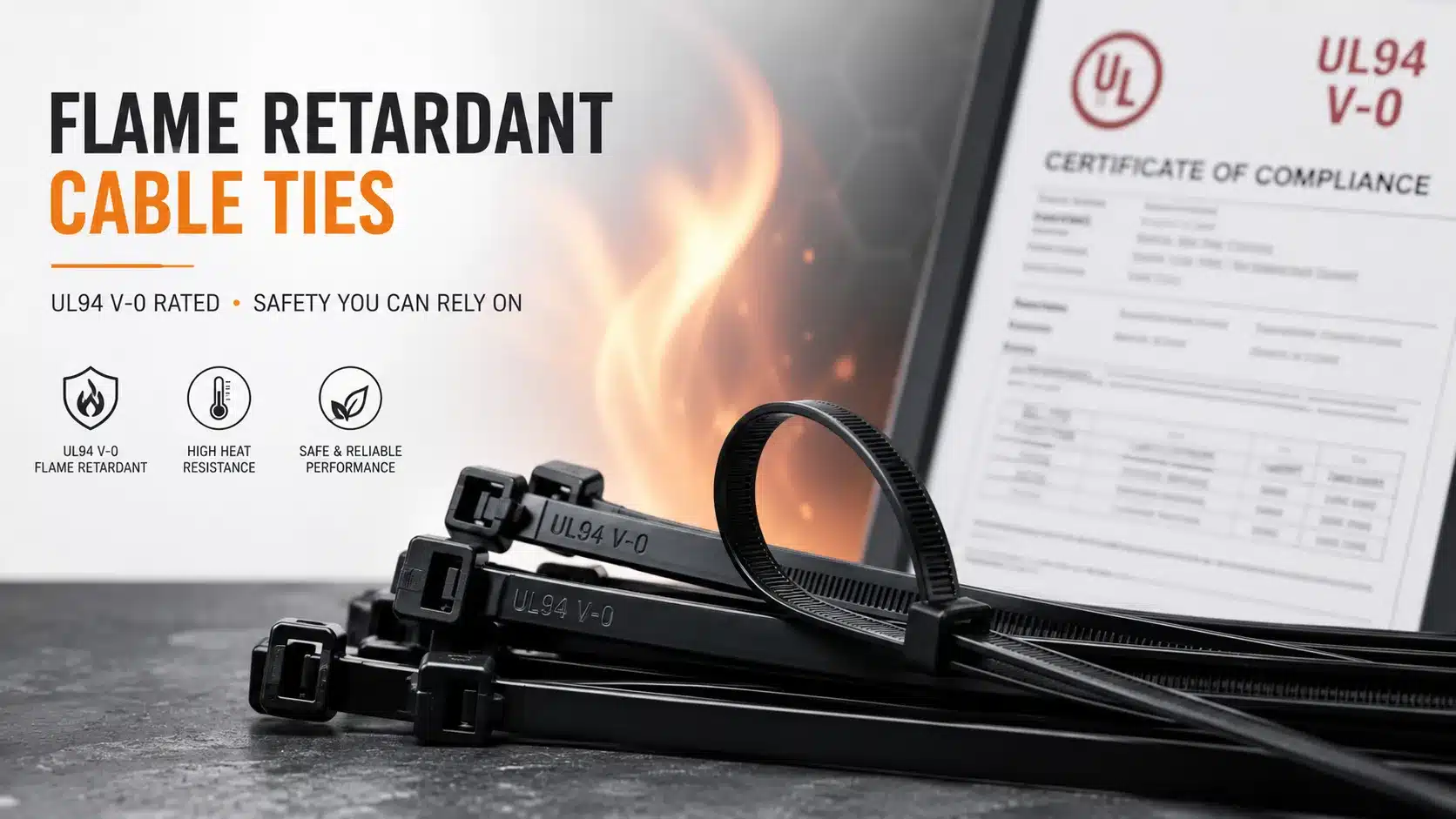
UL94 Flame Retardant Ratings — V-0, V-1, and V-2 Explained
UL 94 is the Standard for Safety of Flammability of Plastic Materials for Parts in Devices and Appliances. It is one of the most referenced standards in cable tie specifications and is critical for any application involving electrical systems, high temperatures, or fire risk environments.
The UL 94 standard classifies plastic materials into three primary ratings based on how quickly they extinguish after ignition and whether they produce flaming drips:
| Rating | Max Burn Time | Flaming Drips | Best For |
|---|---|---|---|
| V-2 | ≤ 30 sec | Allowed | General indoor, low-risk wiring |
| V-1 | ≤ 30 sec | Not allowed | Electrical panels, control cabinets |
| V-0 | ≤ 10 sec | Not allowed | Industrial, automotive, high-risk zones |
For most industrial, automotive, and electrical applications, UL94 V-0 rated cable ties are the recommended choice. Shangbo Plastics nylon cable ties are manufactured using UL94-rated nylon 66 material, offering excellent flame resistance for demanding environments.
ISO 9001 and ISO 14001 — Why the Manufacturer’s Quality Certification Matters
Unlike UL or CE, ISO certifications apply to the manufacturer rather than the individual product. They are arguably the most important indicator of whether a supplier can consistently deliver quality at scale.
ISO 9001:2015 — Quality Management System
ISO 9001 is the international standard for quality management systems. A manufacturer certified to ISO 9001:2015 has demonstrated that they have robust processes in place for:
- Consistent product quality and output
- Traceability of materials and production batches
- Systematic defect identification and prevention
- Customer feedback and continuous improvement
- Supplier evaluation and management
ISO 14001 — Environmental Management
ISO 14001 certifies that a manufacturer operates with an environmental management system, ensuring that production processes minimise environmental impact. This is increasingly important for buyers with sustainability commitments or ESG reporting requirements.
| Shangbo Plastics Note: Yueqing Shangbo Plastic Co., Ltd. holds ISO 9001:2015 certification, independently verified and regularly audited. This means every batch of cable ties we produce meets consistent quality standards, giving you predictable performance across large orders. |

amfori BSCI — Social Compliance Certification
The amfori Business Social Compliance Initiative (BSCI) is an internationally recognised audit framework that assesses manufacturers on social and ethical standards, including:
- Fair labour practices and working conditions
- Freedom of association and collective bargaining
- Health and safety in the workplace
- Environmental responsibility
- Anti-corruption and ethical business conduct
BSCI certification is increasingly required by European retailers, distributors, and procurement departments as part of supply chain due diligence. It gives buyers confidence that their supplier operates ethically and responsibly.
| Shangbo Plastics Note: Shangbo Plastics holds amfori BSCI certification, making us a verified choice for buyers with ethical sourcing requirements or corporate social responsibility (CSR) commitments. |
Certification Requirements by Cable Tie Type
Different cable tie types are used in different environments and applications, so their certification priorities vary. Here is what to look for when sourcing each product type.

Nylon Cable Ties — Nylon 66 (PA66)
Nylon 66 (PA66) is the industry standard material for cable ties, offering an excellent balance of strength, temperature resistance, and chemical stability. When sourcing nylon cable ties, look for:
- UL94 V-0 or V-2 flame retardant rating (material-level)
- RoHS compliance — ensures no restricted substances in colourants or additives
- CE marking — required for electrical applications in Europe
- UL certification — required for North American electrical projects
- ISO 9001 from the manufacturer — guarantees consistent quality
Shangbo Plastics nylon cable ties are made from Nylon 66 (PA66) material, available in natural and black (UV-stabilised) versions. Black nylon cable ties contain carbon black which provides UV resistance for outdoor applications. Explore our full range of nylon cable ties at cabletiesmanufacturer.com/nylon-cable-ties/.

Stainless Steel Cable Ties — 304 and 316 Grade
Stainless steel cable ties are used in the most demanding environments: offshore, marine, chemical plants, outdoor infrastructure, and high-temperature industrial installations. Certifications to look for include:
- Material certification — confirming 304 or 316 grade stainless steel
- CE marking — particularly for use in EU industrial and construction applications
- RoHS compliance — relevant for stainless ties with polymer coatings
- REACH compliance — important for coated variants
- Corrosion resistance test reports
Shangbo Plastics offers both 304 and 316 grade stainless steel cable ties. Grade 316 provides superior resistance to chloride corrosion, making it the preferred choice for marine and coastal environments. View our stainless steel cable tie range at cabletiesmanufacturer.com/stainless-steel-cable-ties/.

Marker / Label Cable Ties
Marker cable ties incorporate a write-on or pre-printed label flag, used for cable identification in complex wiring systems. For industrial and electrical applications, look for:
- UL94 flame rating on the nylon body
- RoHS compliance — especially important as inks and coatings may contain restricted substances
- CE marking for EU markets
- UV resistance if used outdoors
- Chemical resistance to cleaning agents and solvents
Shangbo Plastics marker cable ties are available in multiple sizes and flag configurations, suitable for electrical panels, data centres, and industrial installations. Browse our marker cable ties at cabletiesmanufacturer.com/marker-cable-ties/.

Reusable Cable Ties
Reusable (releasable) cable ties can be unfastened and reused, making them ideal for temporary bundling, testing environments, and applications where cables are regularly reconfigured. Key certifications:
- UL94 flame rating — same as standard nylon ties
- RoHS compliance — critical as releasable mechanisms may use different plastics or metals
- CE marking — for EU market compliance
- Tensile strength documentation — reusable ties have lower tensile strength than standard ties by design
Shangbo Plastics reusable cable ties are manufactured from high-quality nylon 66, offering reliable performance across repeated use cycles. Explore our reusable cable tie range at cabletiesmanufacturer.com/reusable-cable-ties/.
Certification Requirements by Region and Market
One of the most practical questions for importers and distributors is: which certifications do I actually need for my target market? The table below provides a clear summary.
| Region / Market | UL | CE | RoHS | ISO 9001 |
|---|---|---|---|---|
| United States | ✔ Required | ✘ Not needed | Recommended | ✔ Preferred |
| European Union | Accepted | ✔ Required | ✔ Required | ✔ Preferred |
| Middle East | Accepted | Accepted | Recommended | ✔ Preferred |
| Southeast Asia | Accepted | Accepted | Recommended | ✔ Preferred |
| Global / Export | ✔ Preferred | ✔ Preferred | ✔ Required | ✔ Required |
Note: Requirements may vary depending on the specific application (electrical, construction, automotive, etc.) and local regulatory bodies. Always verify with your local compliance authority.
Certification Requirements by Industry
Beyond geography, the industry application also determines which certifications are most critical:
Electrical and Electronics
- UL certification (North America)
- CE + LVD compliance (Europe)
- RoHS compliance — mandatory
- UL94 V-0 flame rating strongly recommended
Automotive and EV Manufacturing
- RoHS compliance — mandatory
- REACH compliance
- High-temperature resistance documentation
- ISO 9001 from manufacturer
Construction and Infrastructure
- CE marking
- UL certification where specified
- Weather and UV resistance documentation
- For stainless ties: material grade certification
Food Processing and Pharmaceutical
- Metal-detectable cable ties with detection certificates
- FDA compliance (for direct food contact environments)
- RoHS compliance
- REACH compliance
Marine and Offshore
- 316 grade stainless steel material certification
- Corrosion resistance test reports
- CE marking
- UV and saltwater resistance documentation
How to Verify a Supplier’s Certifications — Red Flags and Buyer Checklist
Unfortunately, fake or expired certifications are a real problem in the cable tie industry, particularly when sourcing from unknown suppliers. Here is how to protect yourself:
What to Request from Any Cable Tie Supplier
- Full certificate documents with issuing body name, certificate number, and expiry date
- UL certification number — verify on the UL Product iQ database (iq.ul.com)
- RoHS test reports from an accredited third-party laboratory
- ISO 9001 certificate with scope of certification clearly stated
- Declaration of Conformity for CE marking
- amfori BSCI audit report if ethical sourcing is a requirement
Red Flags to Watch For
- Certificates with no expiry date or clearly expired dates
- Certificates issued to a different company name or address
- UL or CE logos used on packaging without a valid certificate number
- Suppliers who cannot provide original documents — only low-resolution scans
- RoHS compliance claimed without a third-party test report
| Shangbo Plastics provides full, verifiable certification documentation to all verified buyers and distributors.
Our certifications include: CE (LVD), RoHS Test Reports (Guangdong Wonder Testing), ISO 9001:2015, UL, and amfori BSCI. Contact us at cabletiesmanufacturer.com to request our full certification package. |

Frequently Asked Questions — Cable Tie Certifications
1. Is UL certification mandatory for cable ties?
UL certification is not universally mandatory, but it is effectively required for cable ties used in electrical installations in the United States and Canada. Many contractors, engineers, and procurement specifications will only accept UL-listed cable ties for wiring and cable management applications.
2. What is CE marking and do I need it?
CE marking indicates compliance with EU safety, health, and environmental directives. If you are selling or distributing cable ties within the European Economic Area, CE marking is legally required. It covers compliance with the Low Voltage Directive and the RoHS Directive.
3. What is the difference between RoHS and REACH?
RoHS restricts specific hazardous substances in electrical and electronic equipment, setting maximum concentration limits. REACH is broader — it governs the registration and safe use of all chemical substances used in manufacturing. Products can be RoHS compliant but still need to address REACH obligations separately.
4. Are RoHS-compliant cable ties safer for workers?
Yes. RoHS compliance ensures that the cable ties do not contain dangerous levels of heavy metals like lead, mercury, or cadmium, nor harmful flame retardants. This reduces health risks for workers handling the ties and for end users in the facility.
5. What does UL94 V-0 mean and why is it important?
UL94 V-0 is the highest flame retardant rating in the UL94 standard. It means the material self-extinguishes within 10 seconds after ignition and produces no flaming drips. For cable ties used in electrical panels, automotive wiring, or industrial environments, V-0 rated ties significantly reduce fire risk.
6. Does ISO 9001 certification apply to cable ties or manufacturers?
ISO 9001 is a quality management system certification that applies to the manufacturing organisation, not the product itself. An ISO 9001:2015 certified manufacturer has demonstrated consistent processes for quality control, traceability, and continuous improvement — which translates directly to more reliable products and fewer defects in large orders.
7. What is amfori BSCI and why does it matter?
amfori BSCI (Business Social Compliance Initiative) is an internationally recognised audit framework that assesses manufacturers on ethical and social standards, including labour rights, workplace health and safety, and environmental responsibility. It is increasingly required by European buyers as part of supply chain due diligence.
8. Which certifications do I need for cable ties in the European Union?
For cable ties sold in the EU, CE marking and RoHS compliance are mandatory. For chemical safety, REACH compliance is also required. For more demanding applications like electrical installations, third-party testing documentation is strongly recommended.
9. Can I use the same certified cable ties for outdoor and indoor applications?
Not always. Indoor cable ties typically require UL94 flame rating and RoHS compliance. Outdoor cable ties additionally need UV stabilisation (black nylon 66 with carbon black additive) and weather resistance. Stainless steel cable ties are preferred for harsh outdoor, marine, or chemical environments.
10. How do I verify that a cable tie supplier’s certifications are genuine?
Request the original certificate documents, check the certificate number against the issuing body’s online database (e.g., UL Product iQ for UL certifications), confirm the certificate is in the supplier’s name and current address, and ensure RoHS reports come from an accredited third-party laboratory.
Conclusion — Choose Certified Cable Ties for Every Application
Certifications are not a formality — they are the foundation of safe, reliable, and legally compliant cable tie sourcing. Whether you need UL-certified ties for North American electrical projects, CE + RoHS compliant ties for European distribution, or ISO 9001-backed quality for large industrial orders, verifying certifications before you buy protects your business and your customers.
At Shangbo Plastics, our entire product range — from nylon cable ties and stainless steel ties to marker cable ties and reusable cable ties — is manufactured to international standards with full certification documentation available.
| Ready to Source Certified Cable Ties?
Contact Shangbo Plastics for certified, compliant, and customisable cable tie solutions for global markets. Available certifications: CE | RoHS | ISO 9001:2015 | UL | amfori BSCI Products: Nylon Cable Ties | Stainless Steel Cable Ties | Marker Cable Ties | Reusable Cable Ties OEM and custom solutions available for importers and distributors worldwide. |


