


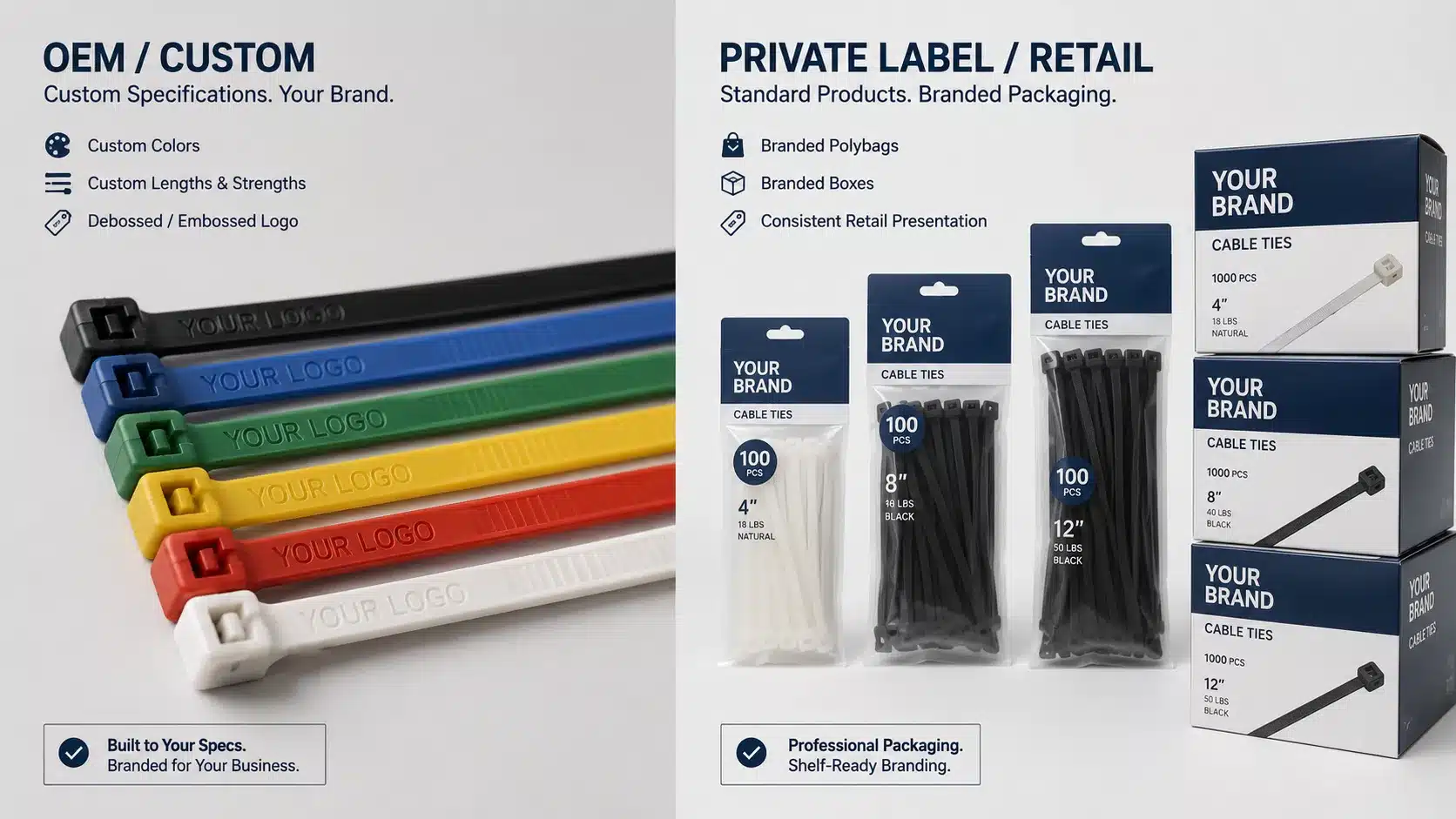
OEM cable ties are manufactured to your custom specifications — sizes, colors, materials, even the head design. Private label cable ties are a factory’s proven catalog products sold under your brand and packaging. One gives you differentiation, the other gives you speed and low startup cost. Choosing the wrong model costs you either margin or market position — here’s how to get it right.
The Quick Answer
Choose private label if you want to start selling fast with low risk: proven products, your branding, flexible MOQs, no tooling cost. Choose OEM if your business depends on a specification nobody else stocks — custom dimensions, special materials, exclusive colors, or your logo molded into the tie itself. Many buyers do both: private label to validate a market, OEM once demand is proven.
What Is Private Label Cable Tie Manufacturing?
With private label, the factory has already done the product development. You choose from an existing, tested range — standard nylon ties, UV-resistant, stainless steel, releasable, and so on — and the factory applies your brand identity to the packaging and, if you want, the product.
Typical private label options include:
- Printed polybags with your logo and barcode — the most cost-effective format for contractor and trade sales.
- Retail packaging — color boxes, blister cards, and PET jars carrying your brand, ready for shelves or e-commerce.
- Custom labels and carton marks for warehouse and distribution traceability.
- Printed cable ties — your logo or text printed on the strap of a standard tie.
Because there’s no product development, there’s no tooling cost and lead times stay short. See the packaging formats we support on our cable tie packing styles page.

What Is OEM Cable Tie Manufacturing?
OEM (Original Equipment Manufacturer) production means the factory builds cable ties to your specification rather than theirs. That can mean:
- Custom dimensions — non-standard lengths, widths, or thicknesses for a specific application.
- Custom colors matched to Pantone or RAL references.
- Special material grades — heat-stabilized, metal-detectable, UV compounds, or flame-retardant formulations for your industry.
- Product-level branding — your logo debossed or printed on the tie itself, not just the bag.
- Engineering collaboration — drawing review, sample iterations, and testing against your requirements.
OEM is how importers and industrial brands build products competitors can’t simply reorder from a catalog — and why choosing an experienced OEM cable tie supplier matters more here than on any catalog order. Our custom zip ties page covers the customization range, and our OEM sourcing guide walks through MOQs and quality steps in detail.
Example OEM Project
A typical OEM project we run looks like this:
- Customer: an automotive parts distributor
- Requirement: black heat-stabilized cable ties for engine-bay wiring harnesses
- Customization: heat-resistant PA66 compound, a non-standard length matched to their harness bundles, and branded polybag packaging
- Result: an exclusive SKU their customers can only reorder through them — samples approved before production, delivered with tensile test documentation

OEM vs ODM vs White Label: Clearing Up the Jargon
These terms get mixed up constantly, so here’s the practical difference. OEM: you supply the specification, the factory manufactures it. ODM (Original Design Manufacturer): the factory designs the product and you brand it — in the cable tie world this overlaps heavily with private label. White label: identical stock product sold to many brands with different labels — the lightest-touch version of private label. For cable ties, the decision that actually matters is the one this article covers: catalog product with your brand, or custom product to your spec.
OEM vs Private Label: Side-by-Side Comparison
| Private Label | OEM | |
| Product design | Factory’s proven catalog products | Built to your specifications |
| Customization depth | Packaging, labels, printed logo on bag/box; printed straps available | Custom lengths, widths, colors (Pantone/RAL), materials, special grades, logo on the tie itself |
| Tooling / startup cost | None — no molds required | Possible tooling and sampling costs, quoted per product |
| MOQ | Flexible, lower entry point | Higher, depends on specification |
| Lead time | Typically 7–25 working days | Typically 25–35 working days including sampling |
| Exclusivity | Product itself is not exclusive — your brand is | Specification can be exclusive to you |
| Risk level | Low — proven product, fast validation | Higher upfront, stronger differentiation |
| Best for | Distributors, wholesalers, new brands testing markets | Established brands, importers, industrial OEMs with unique requirements |
MOQs and lead times vary by product type and specification — confirm with our team when you request a quote.

Cost Comparison: Where the Money Actually Goes
Private label costs are simple: the catalog product price plus packaging printing. Printed polybags add little per unit; retail boxes and blister cards cost more but earn shelf presence. There are no molds and no engineering fees, which is why private label startup costs run far lower.
OEM costs add development on top of unit price: possible tooling for custom molds, color matching, and sample rounds before mass production. Tooling and development costs are quoted per product, depending on the specification — a custom color on a standard size costs far less to set up than a new head design. The payoff is a per-unit spec you own and competitors can’t reorder.
A useful rule: if your customers buy on price and availability, private label protects your margin. If they buy on specification and performance, OEM protects your market.
Which Model Fits Your Business? (Decision Framework)
You’re a distributor or wholesaler
Private label, almost always. Your advantage is range, availability, and relationships — not product design. Branded packaging builds your name with every carton you ship, MOQs stay flexible, and a wholesale cable ties supplier that offers private label lets you stock bulk cable ties across many SKUs without tooling investment.
You’re a brand or importer with specific requirements
OEM. If your market needs a size, color, or material grade that catalog products don’t cover — or your brand promise depends on a product no one else sells — custom manufacturing is the only way to deliver it.
You’re an industrial buyer or equipment manufacturer
OEM with engineering support. When ties go into your machinery, vehicles, or installations, the specification is driven by your application: temperature, vibration, chemical exposure. You want drawing review, samples, and test data — not a catalog guess. Our guide on choosing a dedicated cable tie manufacturer vs a general supplier explains what that support should look like.
The hybrid path most successful buyers take
Start private label to validate demand quickly and cheaply. Once a SKU proves itself, move it to OEM — locking in a spec, better unit economics at volume, and product-level branding. You don’t have to pick one model forever; you have to pick the right model for where your business is now. Our comparison of custom vs standard nylon cable ties helps you judge when a project justifies the custom route.

What to Check Before Signing with Either Model
The sourcing model matters less than the factory behind it. Before committing:
- Material honesty — 100% virgin PA66 holds its rated tensile strength; recycled blends are cheaper and fail sooner. Ask for material test reports.
- Certifications — ISO 9001:2015 quality management, TÜV IEC 62275 type testing, and SGS RoHS compliance at minimum; UL and CE documentation should be available on request. Full breakdown in our certifications buyer’s guide.
- Sample policy — a serious factory sends free samples before production, on both models.
- QC process — in-process checks plus final inspection with tensile testing. See how our quality control works.
- Communication — OEM especially lives or dies on spec clarity, drawing review, and fast sampling feedback.
How the Process Works at Shangbo (Both Models)
First, the factory behind the process. Shangbo Plastics runs 40 plastic injection molding machines, staffed by around 300 skilled workers, producing a range of 1,250+ cable tie styles. As both a private label cable tie manufacturer and a custom cable tie manufacturer for OEM projects, we supply distributors, wholesalers, and industrial customers across more than 40 countries, with over 710 clients served to date. Whichever model you choose, the same production lines, QC lab, and export team handle your order:
- Inquiry — tell us your product type, size, color, material, quantity, packaging, destination country, and application.
- Specification and samples — for private label, choose from our range and send your branding artwork; for OEM, send your spec or drawing for engineering review. Free samples follow.
- Quotation — unit pricing, MOQ, lead time, and any tooling or setup costs, quoted per product.
- Sampling approval — you approve pre-production samples (and packaging proofs) before mass production starts.
- Production and QC — manufacturing with in-process checks and final tensile inspection.
- Packaging and shipping — your branded packaging applied, cartons marked, and export documentation prepared.
Typical lead times run 7–25 working days for standard and private label orders, and 25–35 working days for custom OEM projects including sampling — confirmed at quotation.

FAQs
What does OEM mean for cable ties?
OEM (Original Equipment Manufacturer) means the factory produces cable ties to your specification — custom sizes, colors, materials, or branding on the product itself — rather than selling you its standard catalog items.
What’s the difference between OEM and private label cable ties?
Private label puts your brand on the factory’s existing, proven products, mainly through custom packaging and labels. OEM manufactures a product to your own specification. Private label is faster and cheaper to start; OEM gives you a product competitors can’t reorder from a catalog.
Which is cheaper: OEM or private label?
Private label, at the start — there are no tooling or development costs, just the product plus packaging printing. OEM adds setup costs quoted per product, but at volume a custom spec can deliver better unit economics and stronger margins.
What’s the MOQ for private label cable ties?
MOQs are flexible and depend on product type, size, and packaging format. Custom colors and printed products typically carry higher minimums than standard items — confirm with our team when requesting a quote.
Can I put my logo on the cable tie itself, or just the packaging?
Both. Private label typically brands the packaging (polybags, boxes, blister cards, jars), and printed straps are available on standard ties. OEM projects can go further with logos debossed or molded into the tie.
How long does OEM cable tie production take?
Typically 25–35 working days including sampling and approval, versus 7–25 working days for standard and private label orders. Exact timing is confirmed at quotation based on your specification.
Do private label cable ties come with certifications?
Yes — the underlying products carry the factory’s certifications. Ours are ISO 9001:2015 certified and TÜV IEC 62275 type-tested with SGS RoHS compliance; CE documentation and UL 94 V-2 resin data are available on request.
More answers in our bulk cable ties FAQ.
Start with the Model That Fits You Today
There’s no universally better option — only the right fit for your stage. Private label gets your brand into the market fast on proven products; OEM builds a specification your competitors can’t touch. And you can graduate from one to the other as demand proves out.
With over a decade of cable tie manufacturing experience, 40 injection molding machines, ISO 9001:2015 certification, and TÜV type-tested products, Shangbo Plastics runs both models daily — as OEM cable tie supplier and private label partner — for distributors, importers, and industrial OEMs in 40+ countries.
Request a Bulk Quote or Get Free Samples — tell us your product type, size, color, material, quantity, packaging preference, destination country, and application, and we’ll recommend the sourcing model that fits.


