


If you build, wire, or maintain industrial control panels or machinery enclosures, the choice of cable ties for control panels is one of those specification decisions that looks straightforward on the surface but has significant implications for build quality, compliance, long-term reliability, and the efficiency of any future maintenance work. The wrong cable tie in the wrong environment – the wrong material, wrong tensile strength, wrong temperature rating, or wrong mounting method – does not just look unprofessional. It introduces failure risk into an electrical or mechanical system where failure has real operational consequences.
Industrial control panels and machinery enclosures are demanding environments for cable management products. Depending on the application, a cable tie inside a control panel may need to resist sustained elevated temperatures from transformers and drives, comply with UL flame ratings for electrical safety, survive continuous vibration from attached machinery, remain detectable if it enters a food processing line, or hold an organised cable bundle securely across a service life that matches the panel itself – often ten to twenty years or more. None of those requirements are met by a standard bag of nylon zip ties from a general hardware supplier.
This guide gives you a complete, technically grounded reference for specifying cable ties for industrial control panels and machinery – covering every relevant cable tie type, the wire types and bundle configurations they suit, how to select on tensile strength and temperature rating, what UL and other compliance certifications mean in practice, the full range of mounting and accessory options, and how to match specification to application across the most common industrial panel and machinery environments.
Why Cable Management Matters in Industrial Control Panels
The Cost of Poor Cable Management in Panel Builds
In a well-built industrial control panel, every cable runs where it is supposed to run, is labelled clearly, is bundled at appropriate intervals, and can be traced, tested, and replaced without disturbing adjacent circuits. That level of organisation does not happen by accident – it is the result of a disciplined approach to cable management at every stage of the panel build, from initial wire routing to the final choice of cable tie size, material, and spacing.
The cost of getting this wrong is rarely visible at panel commissioning – it shows up months or years later. A cable tie that degrades in the heat of a motor control panel eventually loses its clamping force, allowing the cable bundle to sag and shift. Movement in a bundle introduces repeated flexing stress at termination points – terminals, connectors, and screw fixings – and that stress eventually causes intermittent faults that are time-consuming and expensive to diagnose. In the worst cases, a degraded or failed cable tie allows cables to contact moving components, sharp panel edges, or heat sources in ways that cause insulation damage, short circuits, or fire.
The cost of specifying the right cable ties for control panels is trivial relative to the build cost of a typical industrial panel. A specification upgrade from standard nylon to heat-stabilised or UL-rated nylon adds pennies per tie. The cost of a field service call to diagnose an intermittent fault caused by a degraded cable bundle is measured in hours of skilled labour, potential production downtime, and in regulated industries, possible compliance implications.
How the Right Cable Ties Improve Panel Safety and Efficiency
Beyond preventing failure, the right cable tie directly improves the build quality, safety, and long-term maintainability of an industrial panel. Correctly selected and correctly installed cable ties hold wire bundles in consistent geometry – which means consistent spacing from heat sources, consistent clearance from circuit breakers and contactors, and consistent routing that a maintenance engineer who did not build the original panel can follow logically.
In regulated industries – food and beverage, pharmaceutical manufacturing, aerospace component production, and nuclear – cable ties are not just a wiring accessory but a component subject to material traceability and compliance requirements. Metal detectable cable ties, LSZH (Low Smoke Zero Halogen) cable ties, and UL listed products are not optional preferences in these environments – they are specified requirements.

Types of Cable Ties for Control Panels and Industrial Machinery
Standard Nylon Cable Ties – PA66 and PA6
Standard nylon cable ties manufactured from polyamide 66 (PA66) or polyamide 6 (PA6) are the most widely used cable management product in general industrial panel builds. PA66 offers higher tensile strength and better resistance to elevated temperatures than PA6, making it the preferred specification for control panel applications where service temperatures are moderate and the panel is in a sheltered, indoor environment.
Standard nylon cable ties for panel use are typically specified in the natural (off-white) or black colour, in widths from 2.5 mm to 9 mm, and with tensile strengths from 18 lbs (80 N) for fine wire management to 120 lbs (540 N) and above for heavier cable looms. For control panel interiors where the wiring environment is clean and dry and operating temperatures stay below 85 degrees C, high-quality PA66 cable ties provide reliable, long-term cable bundling performance at the most cost-effective price point of any option in the range.
Heat-Stabilised Nylon Cable Ties – PA66HS
Heat-stabilised nylon cable ties – sometimes specified as PA66HS or HS nylon – are standard PA66 ties manufactured with a heat-stabilising additive package that extends the reliable upper operating temperature from 85 degrees C to 105 degrees C continuous and higher for intermittent exposure. This is a critical upgrade for control panels housing variable speed drives, frequency inverters, motor starters, and large transformers – components that generate significant radiated heat within the panel enclosure and can push local ambient temperatures well above the standard nylon rating during extended operation.
The difference between standard and heat-stabilised nylon is not visible to the eye – both products look identical. The performance difference only becomes apparent when the tie is subjected to sustained elevated temperature over time. A standard nylon tie at 95 degrees C will become progressively more brittle and lose clamping force over months of operation; a heat-stabilised cable tie in the same environment maintains its mechanical properties and continues to hold the cable bundle securely.
Low-Smoke Halogen-Free (LSZH) Cable Ties
Low-Smoke Zero Halogen (LSZH) cable ties – also specified as LSOH or halogen-free cable ties – are manufactured from polymer formulations that, when exposed to fire, produce significantly lower volumes of smoke and do not emit toxic halogen gases (chlorine, bromine, fluorine) that cause serious secondary hazards in confined spaces. Standard nylon and PVC-based products, when burning, release hydrogen chloride and other toxic compounds that are as dangerous to personnel as the fire itself.
LSZH cable ties comply with UL 94V-0 and equivalent international flame ratings – the highest standard of self-extinguishing behaviour – and are specified for rolling stock (rail vehicles), public building electrical infrastructure, aircraft interiors, and any panel installation in a location where personnel evacuation in a fire event may be restricted or delayed.

Metal Detectable Cable Ties for Food and Pharmaceutical Manufacturing
Metal detectable cable ties are manufactured from nylon (polyamide) compounded with a specific additive that makes the tie detectable by standard industrial metal detection equipment – the same systems used on food production lines to detect and reject contaminated product. If a cable tie fails in a food processing environment and a fragment enters the product stream, a standard nylon tie passes undetected through every downstream quality check. A metal detectable cable tie triggers the detection system and allows the contaminated product to be rejected before it leaves the facility.
Metal detectable cable ties are mandatory in HACCP-compliant food production environments and are increasingly specified in pharmaceutical and medical device manufacturing where foreign body contamination control is a regulatory requirement. They are available in a distinctive blue colour for high visual contrast against most food products, and in the same range of sizes and tensile strengths as standard nylon ties.
Stainless Steel Cable Ties for Harsh Industrial Environments
Where the environment of the control panel or machinery enclosure exceeds the capability of any nylon product – extreme temperatures, continuous chemical exposure, outdoor installation in corrosive atmospheres, or permanent structural installations – stainless steel cable ties are the correct specification. Grade 304 stainless is appropriate for most industrial panel outdoor enclosures, high-temperature machinery environments, and chemical plant control panels. Grade 316 is required where saltwater, chloride-bearing chemicals, or marine atmospheres are involved.
The tensile strength of stainless steel cable ties – from 180 lbs at 4.6 mm width to over 600 lbs at 19 mm – far exceeds anything available in nylon, making them the appropriate product for securing large, heavy cable looms in industrial machinery, offshore panel enclosures, and any application where the combined weight of the cable bundle and dynamic mechanical loads would stress a nylon tie beyond its reliable operating range.
Releasable and Reusable Cable Ties for Maintenance-Access Panels
Releasable cable ties – also called reusable cable ties – use a release tab mechanism that allows the tie to be unfastened and re-tensioned without cutting. For industrial control panels that require regular maintenance access – test rigs, commissioning panels, modular machine enclosures, and panels with known annual inspection requirements – releasable cable ties reduce the consumable cost associated with cutting and replacing standard ties on every service visit.
Releasable ties are not appropriate for permanent panel builds or any application where the tie is a structural or safety element. For maintenance-focused applications, however, they are the practical and cost-efficient choice.
Key Specifications to Consider When Choosing Control Panel Cable Ties
Wire Types, Bundle Diameter, and Size Selection
The size of cable tie required for a given application is determined by two factors: the diameter of the cable bundle being secured, and the tensile load the tie needs to hold. Bundle diameter determines the length of tie needed – the tie must be long enough to wrap fully around the bundle and pass through the locking head with sufficient tail for proper engagement. Tensile load – the combined weight of the cables in the bundle plus any dynamic load from vibration or movement – determines the minimum tensile strength rating required.
For typical control panel wiring, where bundles are light and the environment is sheltered, narrow ties in the 2.5 mm to 4.8 mm width range are appropriate for individual wire management, and wider ties in the 7.6 mm to 9 mm range are suited for larger cable bundles and main loom runs. For industrial machinery where heavier wire types – power cables, armoured cables, and multi-core looms – are involved, wider and heavier-duty ties with higher tensile ratings are required.
Temperature Rating and Thermal Environment
The thermal environment inside an industrial control panel is often significantly warmer than the ambient temperature outside it. Power components – variable speed drives, contactors, transformers, servo amplifiers – generate substantial heat during operation, and in a sealed or partially sealed enclosure, this heat accumulates. A panel operating in a 25 degrees C ambient environment may have local temperatures near heat-generating components of 70 to 90 degrees C or above during peak load conditions.
Standard nylon (PA66) is rated to 85 degrees C. Heat-stabilised nylon extends this to 105 degrees C. For panels with high power density, inadequate ventilation, or applications in hot ambient environments – foundries, engine rooms, outdoor tropical installations – heat-stabilised or stainless steel cable ties are the correct product specification.
UL Certification and Electrical Compliance
For industrial control panels sold into North American markets, UL listed cable ties are frequently a contractual or regulatory requirement. UL certification for cable ties covers two primary standards: UL 94V-2 (self-extinguishing within 30 seconds, tested at a 30-degree angle) and UL 94V-0 (self-extinguishing within 10 seconds, tested vertically – the more stringent standard used for panels in safety-critical applications and LSZH products). Specifying UL listed cable ties in a panel destined for a UL-listed panel assembly is not optional – it is part of the component specification that the listing covers.
Shangbo’s nylon cable tie range includes UL 94V-2 rated options across standard and heat-stabilised PA66, with resin flame-rating data for panel builders. For a UL-listed assembly, confirm with your certifier whether a UL-listed cable tie is required. CE marking and RoHS compliance are standard across our range, covering electrical equipment sold into European markets. Our ISO 9001:2015 certified manufacturing process ensures consistent production quality and provides the traceability documentation that regulated-industry procurement increasingly requires.
Chemical Resistance for Machinery Environments
Industrial machinery enclosures are frequently exposed to the same chemical environment as the process they control – cutting fluids and lubricants in CNC machinery, cleaning agents in food and pharmaceutical equipment, hydraulic fluids in heavy plant, and process chemicals in production machinery. Standard nylon 66 cable ties have good resistance to most non-aromatic hydrocarbons, oils, and dilute acids, but their resistance to strong acids, concentrated alkalis, and halogenated solvents is limited.
For chemical environments that fall outside the reliable resistance envelope of nylon, stainless steel cable ties or specialist polymer ties provide the necessary chemical resistance. Grade 316 stainless steel handles the vast majority of industrial chemical exposure, including cleaning agents, process chemicals, and salt-bearing environments.
Cable Tie Type Comparison for Control Panel and Machinery Applications
The following table consolidates the key specifications across all cable tie types relevant to industrial control panel and machinery applications.
| Cable Tie Type | Material | Temp. Range | Tensile Strength | UL 94 Flame Rating | Best Control Panel / Machinery Use |
| Standard Nylon 66 | PA66 (Polyamide 66) | -20 to +85 deg C | 18-250 lbs | UL 94V-2 available | General indoor panel wiring, low-heat environments |
| Heat-Stabilised Nylon 66 | PA66 + heat stabiliser | -20 to +105 deg C | 18-250 lbs | UL 94V-2 available | Motor control panels, drives, switchgear enclosures |
| Low-Smoke Halogen-Free | PA66 LSOH / LSZH | -20 to +85 deg C | 18-175 lbs | UL 94V-0 available | Rolling stock, public building panels, safety-critical builds |
| Metal Detectable Nylon | PA66 + metal additive | -20 to +85 deg C | 18-175 lbs | Available | Food & pharma machinery, HACCP environments |
| Stainless Steel 304 | Grade 304 SS | -60 to +300 deg C | 180-600+ lbs | N/A – metal | High-temp industrial machinery, outdoor panels |
| Stainless Steel 316 | Grade 316 SS | -60 to +300 deg C | 180-600+ lbs | N/A – metal | Marine control panels, chemical plant, offshore |
| Releasable Nylon | PA66 | -20 to +85 deg C | 18-120 lbs | Available | Maintenance-access panels, testing environments |
| Black UV-Stabilised Nylon | PA66 + UV stabiliser + carbon black | -20 to +85 deg C | 18-250 lbs | UL 94V-2 available | Outdoor control enclosures, solar inverter panels |

Cable Tie Applications Across Industrial Machinery and Panel Types
Electrical Distribution Boards and Switchgear
In electrical distribution boards and switchgear assemblies, cable ties are used to organise incoming and outgoing cable runs, secure busbars and earth cables, and manage the control wiring between circuit breakers, contactors, relays, and metering equipment. The combination of live electrical components, significant electrical loads, and the need for absolute compliance with relevant standards – IEC 61439 in Europe, UL 891 in North America – makes correct cable tie specification a mandatory engineering requirement.
Heat-stabilised PA66 is the standard specification for switchgear panel wiring where temperatures can be elevated by high-current busbar connections. UL listed cable ties are required for switchgear assemblies carrying a UL listing. LSZH ties are specified where the switchgear is installed in a confined space or in a public building where fire safety standards demand low-smoke materials throughout the assembly.
CNC Machinery and Automation Equipment
CNC machine tools, robotic automation cells, and programmable logic controller (PLC) enclosures represent a specific cable management challenge because the cable bundles inside these systems are subject to continuous vibration from servo motors, spindle drives, and mechanical movement – and this vibration is transmitted directly to the cable ties securing the wiring looms. Over time, vibration-induced fatigue loosens the clamping force of undertensioned ties and progressively stresses the cable insulation at bundling points.
For CNC and automation applications, screw-mount or push-mount cable tie bases provide a more vibration-resistant fixing than adhesive mounts alone, and heat-stabilised PA66 cable ties with a tensile rating appropriate for the loom weight provide the mechanical resilience that standard ties lack. Where the machine enclosure is exposed to cutting fluid mist or coolant splash – common in CNC turning and machining centres – ties with adequate chemical resistance to the specific coolant formulation should be confirmed before specification.
Automotive and Aerospace Manufacturing Machinery
In automotive manufacturing plants and aerospace component production facilities, the machinery that builds the products is subject to cable management requirements as demanding as the products themselves. Production line conveyors, robotic welding and assembly cells, automated inspection systems, and CNC machining centres all have control panel and machinery enclosures that must maintain reliable electrical operation across extended production shifts.
In aerospace component manufacturing, where cleanliness standards, material traceability, and foreign object debris (FOD) control are paramount, metal detectable cable ties are increasingly specified even on machinery enclosures – not just on production line equipment – because any fragment entering the component manufacturing area is a potential FOD hazard. The specification logic is the same as in food processing: detectable materials throughout the production environment are a defence against contamination risk at every level.
Heavy Industrial and Process Machinery
In heavy industrial and process machinery applications – mineral processing, petrochemical refining, cement and aggregates production, steel manufacturing – control panel and machinery cable management is exposed to the most demanding combination of factors in the industrial spectrum: high ambient temperatures, chemical and particulate contamination, continuous structural vibration, and often outdoor or semi-outdoor installation conditions. Stainless steel cable ties are the standard specification for any permanent installation in this sector.
For process industry control panels mounted outdoors or in partially exposed locations, UV-stabilised nylon or Grade 304 stainless steel provides appropriate weather and UV resistance. For panels inside chemical process buildings where specific chemical exposure is a concern, Grade 316 stainless or specialist polymer ties may be required depending on the chemical environment.
Mounting Methods and Accessories for Control Panel Cable Management
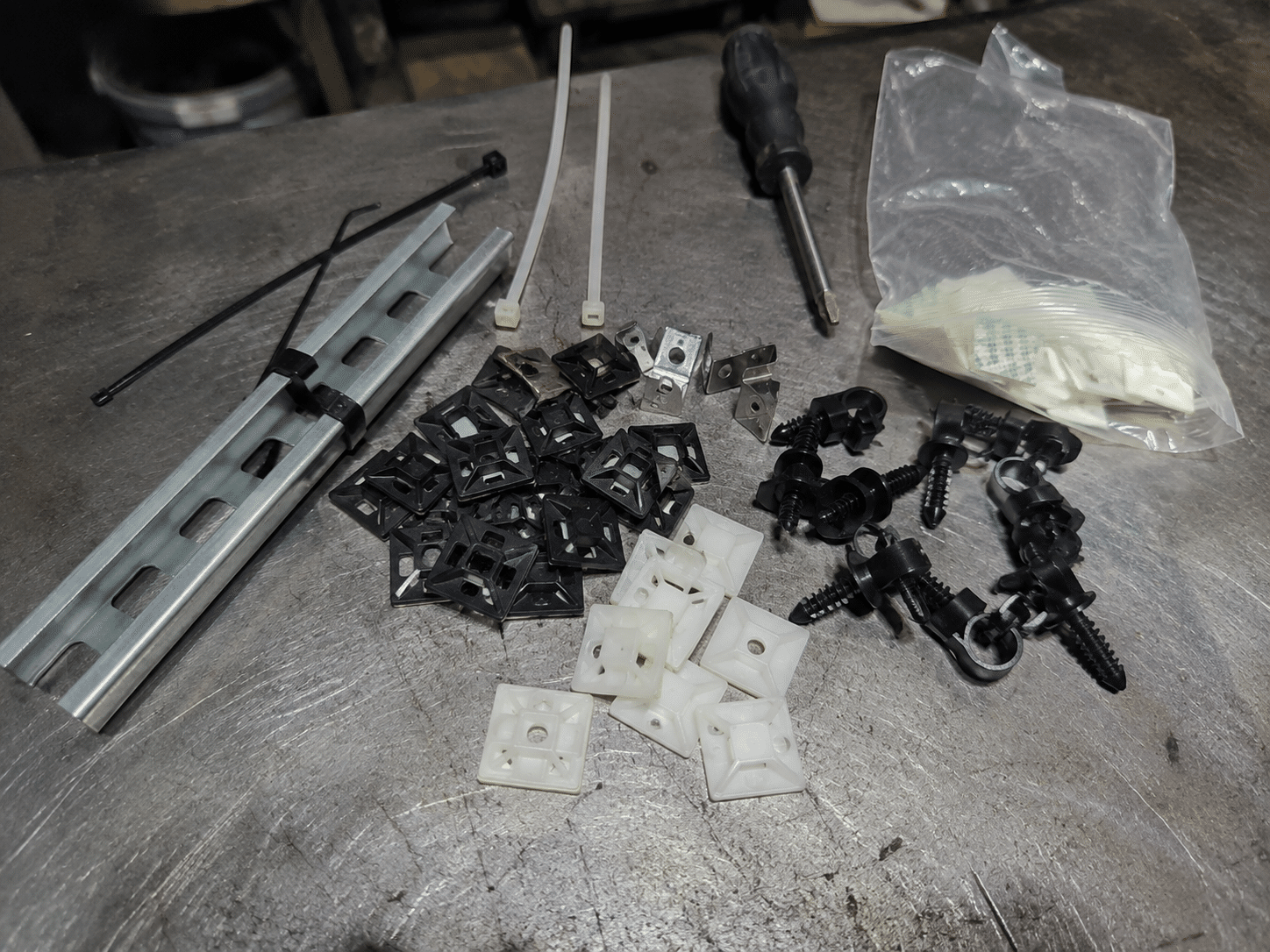
Selecting the right cable tie is only part of the specification decision for a complete cable management system. The method by which the cable tie and its bundle are fixed to the panel structure – the mounting accessory – is equally important, because the mount determines how securely the cable run is positioned within the panel and how well it survives vibration, thermal cycling, and the mechanical disturbance of maintenance work.
| Mounting / Accessory Type | How It Works | Best Application in Panels & Machinery | Key Advantage |
| Adhesive cable tie mount | Self-adhesive pad bonds to panel surface; tie loops through slot | Smooth panel walls, DIN rail surrounds, cabinet interiors | No drilling required – fast installation |
| Screw-mount cable tie base | Plastic or metal base with centre screw hole; tie threads through | High-vibration machinery enclosures, permanent panel builds | Secure mechanical fixing – vibration resistant |
| Edge clip / edge mount | Clips onto panel sheet metal edge or lip | Panel door wiring runs, edge routing of cable looms | Clean routing along panel edges without adhesives |
| Push-mount tie (integrated anchor) | Tie with moulded push-in anchor for pre-punched holes | OEM machinery builds with tooled panels and standard hole patterns | Single-piece install – faster on volume production |
| Releasable cable tie loop | Tie with release tab – unfastenable without cutting | Maintenance panels needing regular access for inspection | Reusable – reduces consumable cost on service panels |
| DIN rail cable tie saddle | Snaps directly onto 35 mm DIN rail; tie secures cable bundle | Control panel DIN rail wiring, PLC and relay cable management | Purpose-designed for DIN rail – no additional hardware |
| Conduit tie (P-clip style) | Wraps around conduit or pipe; secures to structure via tie | Machinery frame cable routing, rigid conduit management | Holds conduit and cable together in a single fixing |

How to Install Cable Ties in Control Panels Correctly
Correct installation of cable ties for control panels is as important as correct product selection. Poorly installed ties – over-tensioned, under-tensioned, incorrectly spaced, or improperly trimmed – undermine the performance of even the best cable tie product.
Tensioning is the most critical installation variable. Cable ties in control panels should be tensioned to the point where the bundle is firmly held and cannot shift or rotate under normal handling, but not so tight that the tie edge cuts into or deforms the cable insulation. Over-tensioning is a particularly common error in panel wiring – an excessively tight tie creates a stress concentration at the tie edge that can damage cable insulation over time. Using a tensioning tool calibrated for the appropriate tie width eliminates this variability and produces consistent, professional results throughout the panel build.
Tie spacing within a cable run affects both the mechanical support of the bundle and the thermal management of the cables. As a general engineering guideline, spacing of 150 mm to 300 mm is appropriate for most control panel cable runs. Wider spacing allows the bundle to sag and flex between fixing points; tighter spacing than necessary adds cost and assembly time without meaningful benefit.
Tail trimming after tensioning is a professional requirement, not a cosmetic preference. Every cable tie tail must be cut flush with the locking head using an appropriate flush-cut tool. A protruding tail is a hand-injury hazard for any maintenance engineer who subsequently works inside the panel, and in a live panel it is a potential short-circuit risk if the tail contacts an adjacent circuit or conductor.
Sourcing Cable Ties for Industrial Panels – What to Look for in a Supplier
The cable tie supply market contains a wide range of quality levels, and the performance difference between a correctly specified, professionally manufactured cable tie and a commodity product at the bottom of the market is real – it just may not be visible until the installation has been in service for a year or two. The factors that distinguish a professional supplier from a commodity source are consistent dimensional tolerances, certified material compliance, and the availability of documentation.
Dimensional consistency – particularly in strap width, thickness, and locking head geometry – determines whether the tie achieves its rated tensile strength reliably across the full production batch. At Shangbo, every production batch undergoes tensile pull-out testing as part of our standard quality control process under our ISO 9001:2015 certified quality management system.
Material certification – UL listing documentation, CE declaration of conformity, RoHS compliance certificate, material test reports for metal detectable or LSZH products – should be available from the manufacturer on request without significant lead time. For regulated-industry procurement, the ability to provide this documentation quickly and completely is a basic competency expectation. Undocumented compliance is not compliance.
Frequently Asked Questions
What are the best cable ties for industrial control panels?
The best cable ties for control panels depend on the specific thermal, chemical, and compliance environment of the panel. For standard indoor panels in moderate-temperature environments, high-quality PA66 nylon cable ties rated UL 94V-2 are the appropriate baseline specification. For panels containing high-power drives or contactors, heat-stabilised PA66HS is the professional upgrade. For panels in outdoor, marine, or high-temperature environments, stainless steel cable ties are the correct specification.
Do cable ties for control panels need to be UL listed?
For control panel assemblies that carry a UL listing – or for panels built to UL standards for the North American market – UL listed cable ties are typically required as part of the panel listing specification. The applicable UL standard for cable ties is UL 62275, and cable ties used in listed panel assemblies should comply with the relevant flame rating – typically UL 94V-2 as a minimum, with UL 94V-0 required in safety-critical or confined-space installations.
What temperature rating do I need for control panel cable ties?
The temperature rating required depends on the actual operating temperature inside the panel enclosure. As a practical guide: standard PA66 nylon (rated to 85 degrees C) is appropriate for panels with modest heat generation and good ventilation. Heat-stabilised PA66HS (rated to 105 degrees C) is the correct specification for panels housing variable speed drives, motor starters, and large contactors. Stainless steel cable ties (rated to 300 degrees C continuous) are required for panels adjacent to high-temperature process equipment.
What are metal detectable cable ties and when do I need them?
Metal detectable cable ties are nylon cable ties manufactured with a metal-detectable additive that makes them visible to industrial X-ray and metal detection equipment used in food and pharmaceutical production quality control systems. They are required in any food processing, beverage production, or pharmaceutical manufacturing machinery installation where a HACCP contamination control plan is in place. They are typically blue in colour for high visual contrast and are available in the same sizes and tensile ratings as standard nylon ties.
Can I use the same cable ties inside a panel and on the external machinery?
Not necessarily – the environment inside a control panel and the environment on the external structure of the machinery it controls may be quite different. Inside the panel, heat, UL compliance, and dimensional consistency are the primary concerns. On the external machinery structure, UV exposure, chemical contact, vibration, and in some environments moisture or wash-down are the primary factors. UV-stabilised nylon or stainless steel cable ties are appropriate for external machinery use in most industrial environments.
What is the correct spacing for cable ties in a control panel?
As a general engineering guideline, cable ties in a control panel should be spaced at intervals of 150 mm to 300 mm along a cable run, with ties positioned at directional changes and entry/exit points regardless of the general spacing interval. Bundles carrying heavy cables or cables subject to vibration from attached machinery should be tied at the tighter end of this range.
What mounting accessories do I need for control panel cable management?
The most commonly used mounting accessories for control panel cable management are adhesive cable tie mounts for smooth panel walls, screw-mount bases for vibration-exposed applications, and DIN rail cable tie saddles for PLC and relay wiring on standard 35 mm DIN rail. Push-mount ties with integrated anchors are efficient for OEM panel builds where the panel is tooled with standard hole patterns.
Does Shangbo supply cable ties with certification documentation for industrial use?
Yes. Shangbo’s cable tie range is manufactured under an ISO 9001:2015 certified quality management system and our products carry CE and RoHS compliance across our nylon range, made from UL 94 V-2 rated resin. Documentation – including resin UL 94 data, CE declaration of conformity, RoHS compliance certificate, and batch-level test data – is available on request for all certified product lines.
Conclusion: Specify the Right Cable Tie and Build the Right Panel
The choice of cable ties for industrial control panels and machinery is not a commodity decision – it is a specification decision that affects the quality, compliance, reliability, and serviceability of every panel you build and every machine you wire. The range of cable tie types available for industrial panel use is broader than most buyers realise, and the performance differences between them are real and significant in the operating environments that industrial panels actually face.
Standard PA66 nylon for general indoor panels. Heat-stabilised nylon for high-power component enclosures. UL 94 V-0 rated ties for safety-critical panel assemblies. LSZH for confined-space and public-building installations. Metal detectable cable ties for food and pharmaceutical machinery. Stainless steel cable ties for outdoor, marine, chemical, and high-temperature panel environments. Each specification exists because a different environment demands it.
At Shangbo, we supply cable ties for control panels and industrial machinery to panel builders, OEM machinery manufacturers, and engineering procurement teams across 20+ countries. Our range covers every specification in this guide, manufactured to ISO 9001:2015 standards and supported by CE and RoHS documentation and UL 94 V-2 resin data. If you are not sure which cable tie is right for your specific application, our technical team will give you a clear answer.


